Why Learning Alone Feels So Hard (And What to Do Instead)

Abiodun Adekunle
Social Media Strategist at Uvivio
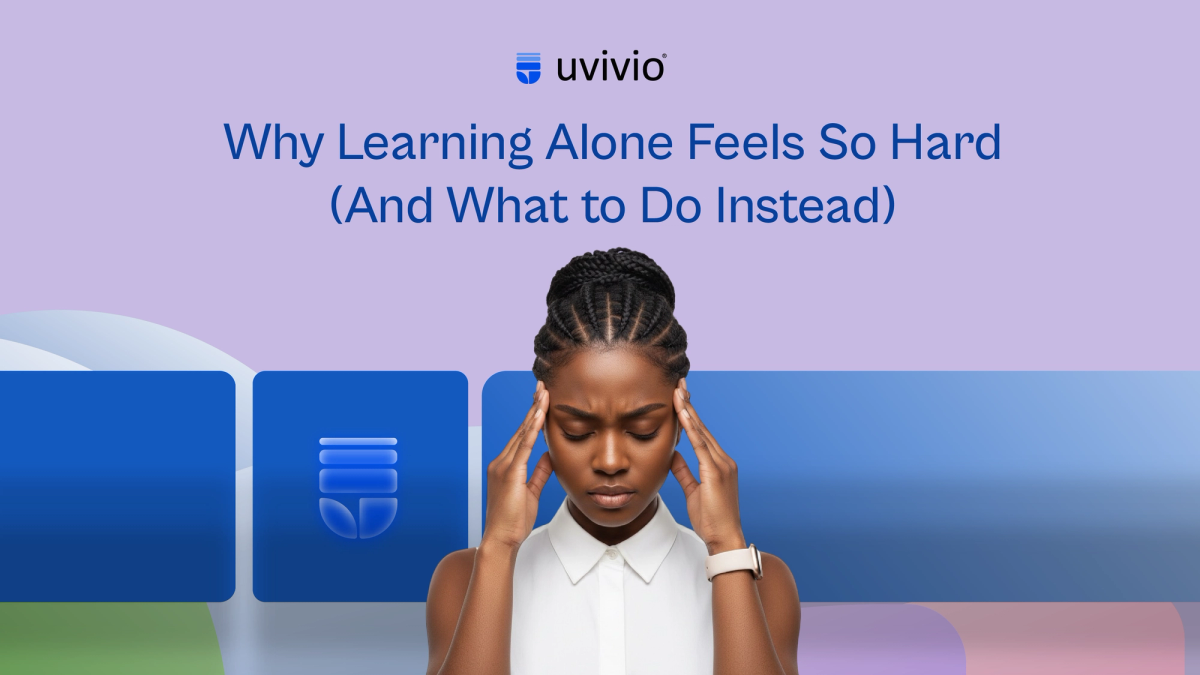
If Learning Alone Feels Hard, You’re Not Broken
If learning on your own feels harder than you expected, you’re not weak, lazy, or incapable.
You’re human.
Many motivated, intelligent people start learning something new with excitement, only to feel confused, overwhelmed, or stuck a few weeks in. Progress slows. Confidence drops. And eventually, learning starts to feel heavy instead of empowering.
This struggle isn’t a personal failure. It’s a structural one.
In this article, we will explore why learning alone feels so hard, even for capable learners, and what actually helps when self-learning stops working. The goal isn’t to convince you to try harder, but to help you understand how learning really works and how to learn more effectively.
The Real Reasons Learning Alone Feels Difficult
1. Lack of Feedback
One of the biggest challenges of learning alone is not knowing whether you’re doing things right.
- Is this the correct approach?
- Am I improving?
- Am I practicing the right things?
Without feedback, progress becomes invisible. And when progress is invisible, motivation fades. You may be learning but you can’t tell.
2. Decision Fatigue
Self-learning requires constant decisions:
- What should I learn next?
- Which resource is best?
- When is good enough good enough?
Each decision drains mental energy. Over time, this cognitive overload leads to learning fatigue. You spend more time choosing what to learn than actually learning.
3. Motivation Without Accountability
Motivation is unreliable without structure.
When no one is aware of your goals, checks your progress, or expects consistency, it’s easy to drift. This isn’t about discipline, it’s about human behavior. We’re wired to perform better when our efforts are seen and supported.
4. Blind Spots You Can’t See:
Beginners often focus on what feels important, not what actually is.
Without experience, it’s hard to know:
- Which fundamentals matter most
- What can be skipped
- Where mistakes are forming
These blind spots slow progress and create frustration.
Why More Content Is Not the Solution
When learning feels hard, the default response is often to consume more:
- Another course
- Another tutorial
- Another playlist
But more content doesn’t automatically lead to clarity.
In fact, over-consumption often increases confusion. You’re exposed to conflicting opinions, different methods, and endless frameworks without guidance on how they fit together.
What started as free learning becomes costly in time, energy, and confidence.
How Humans Actually Learn Best
Learning isn’t just an individual activity, it’s a social process.
We learn best when we have:
- Feedback on our attempts
- Models to observe
- Corrections early in the process
- Context for why something matters
This is why apprenticeships, coaching, and mentorship have existed long before online courses. Guided learning shortens the learning curve not because it replaces effort, but because it directs effort toward what matters.
No academic overload is needed to see this, it’s how humans have always learned.
The Difference Between Learning Alone and Learning Independently
This distinction changes everything. Learning alone means unsupported, unguided, and isolated. Learning independently means self-directed, but guided.
Independent learners still seek feedback. They still ask questions. They still use support systems, they just take ownership of the process.
Confusing these two is why so many learners struggle in silence.
What to Do Instead: Smarter Alternatives to Learning Alone
1. Learn With Direction, Not Just Resources
A roadmap is more powerful than unlimited content.
When you know:
- What to focus on now
- What can wait
- What success looks like
Learning becomes lighter and more purposeful.
2. Seek Feedback Early
Waiting too long for feedback compounds mistakes.
Early correction:
- Saves time
- Builds confidence
- Prevents bad habits
It’s easier to adjust early than to unlearn later.
3. Use Mentorship to Shorten the Learning Curve
Mentors don’t replace effort they refine it.
They help you:
- Prioritize what matters
- Validate your approach
- Avoid common pitfalls
- Translate theory into real-world application
At its best, mentorship is about clarity and acceleration, not dependency.
A Simple Framework for Supported Learning: S.U.P.P.O.R.T
Frameworks help turn insight into action.
- Structure: Clear learning paths
- Understanding goals: Knowing why you’re learning
- Personalised guidance: Advice that fits your context
- Practice with feedback: Learning by doing
- Observation of experts: Seeing how it’s applied
- Reflection: Reviewing what worked and why
Time consistency: Sustainable progress over intensity
This framework reflects how effective learning actually happens.
Signs You Need Support (Not More Willpower)
If any of these feel familiar, it’s not a discipline problem:
- Starting many courses but finishing few
- Repeatedly switching learning paths
- Constant self-doubt
- Difficulty applying what you learn in real life
Seeking support doesn’t mean you’ve failed. It means you’ve noticed a pattern and you’re responding wisely.
Common Misconceptions About Mentorship and Guided Learning
It’s a crutch.
Guidance accelerates growth; it doesn’t replace effort.
I should figure it out myself.
Growth isn’t measured by how alone you were.
It’s only for beginners.
Experienced professionals often benefit the most from perspective and feedback.
Support isn’t a shortcut, it’s a multiplier.
You’re Not Meant to Learn Everything Alone
Learning struggles are human, not personal flaws.
The strongest learners aren’t the ones who suffer in silence, they’re the ones who build systems around themselves. They choose guidance over isolation and progress over pride.
You don’t have to learn everything alone.
You were never meant to.
Learn with people, not just content.
Choose clarity. Choose support. Choose progress.
Teach smarter with Uvivio
Uvivio aligns mentors and mentees around clear goals, structured lessons, and tight feedback loops—so every session builds momentum.
Get started now